Cognitive Offloading
Interpretation, synthesis and judgement can increasingly be delegated to AI, reducing the immediate cognitive effort required from the user.
Better thinkers, not faster answers.
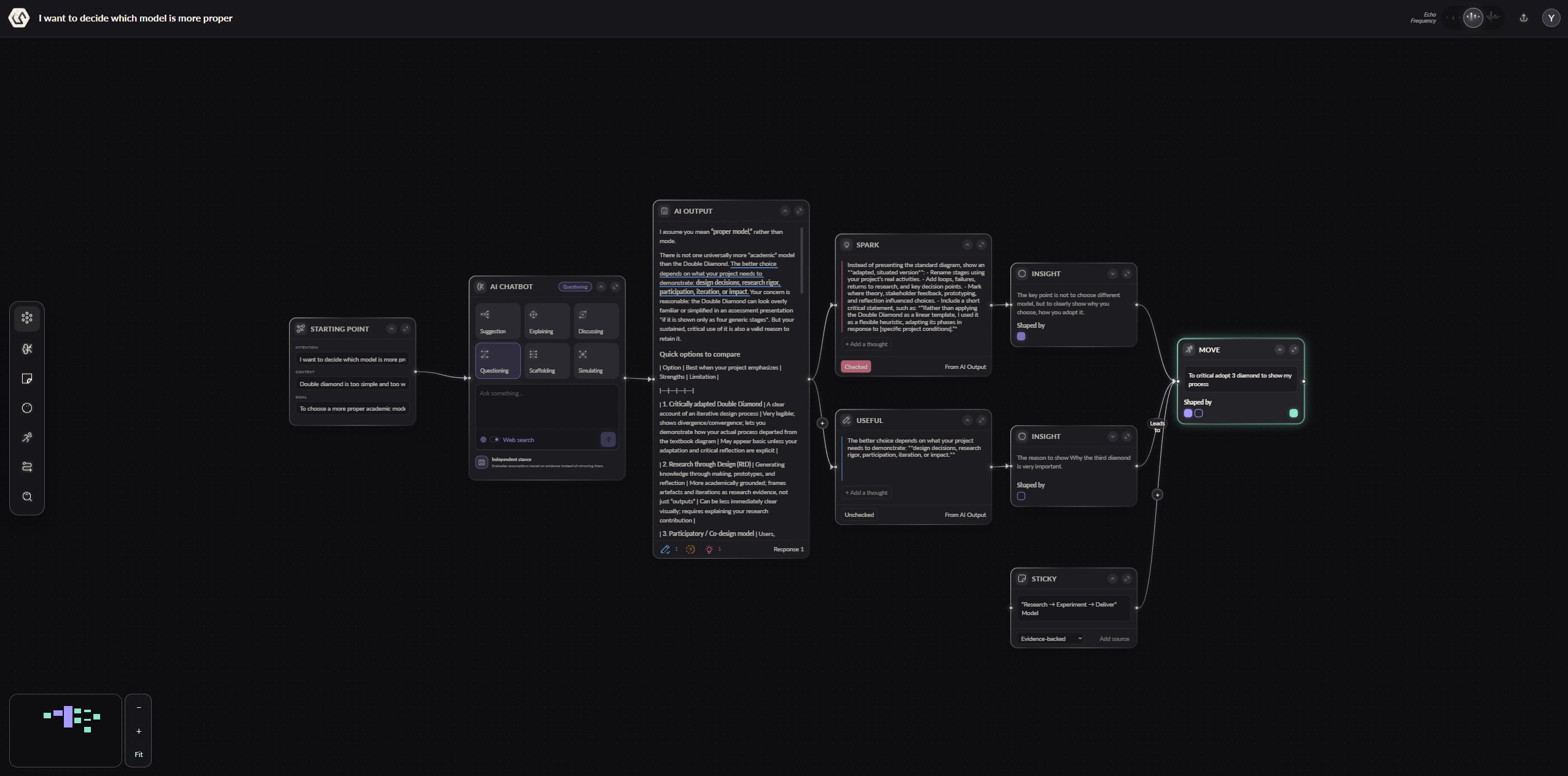
Second Thought is a spatial Human–AI reasoning workspace designed to keep people actively involved in thinking with generative AI.
It makes context, contribution and judgement visible — giving users more control over how AI participates in their reasoning.
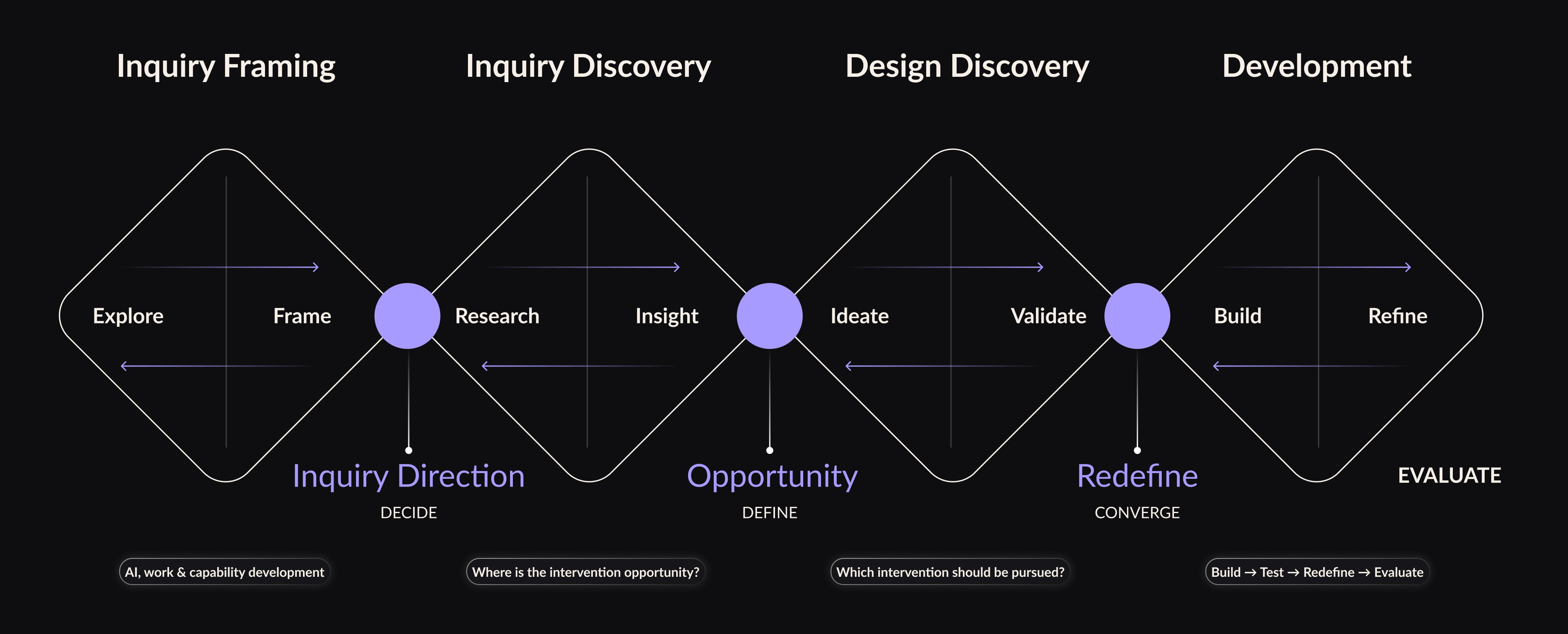
As generative AI becomes embedded in design work, polished outputs are becoming easier to produce. But capabilities such as questioning, interpretation and contextual judgement develop through repeated practice — especially when people have to work through uncertainty themselves.
My research suggested that AI could disrupt this development through both individual cognitive processes and educational processes.
Interpretation, synthesis and judgement can increasingly be delegated to AI, reducing the immediate cognitive effort required from the user.
Fluent and coherent AI responses can create confidence before the user has fully understood, questioned or verified the output.
Instead of working through what is unknown, users can ask AI to define the direction, interpretation or next step for them.
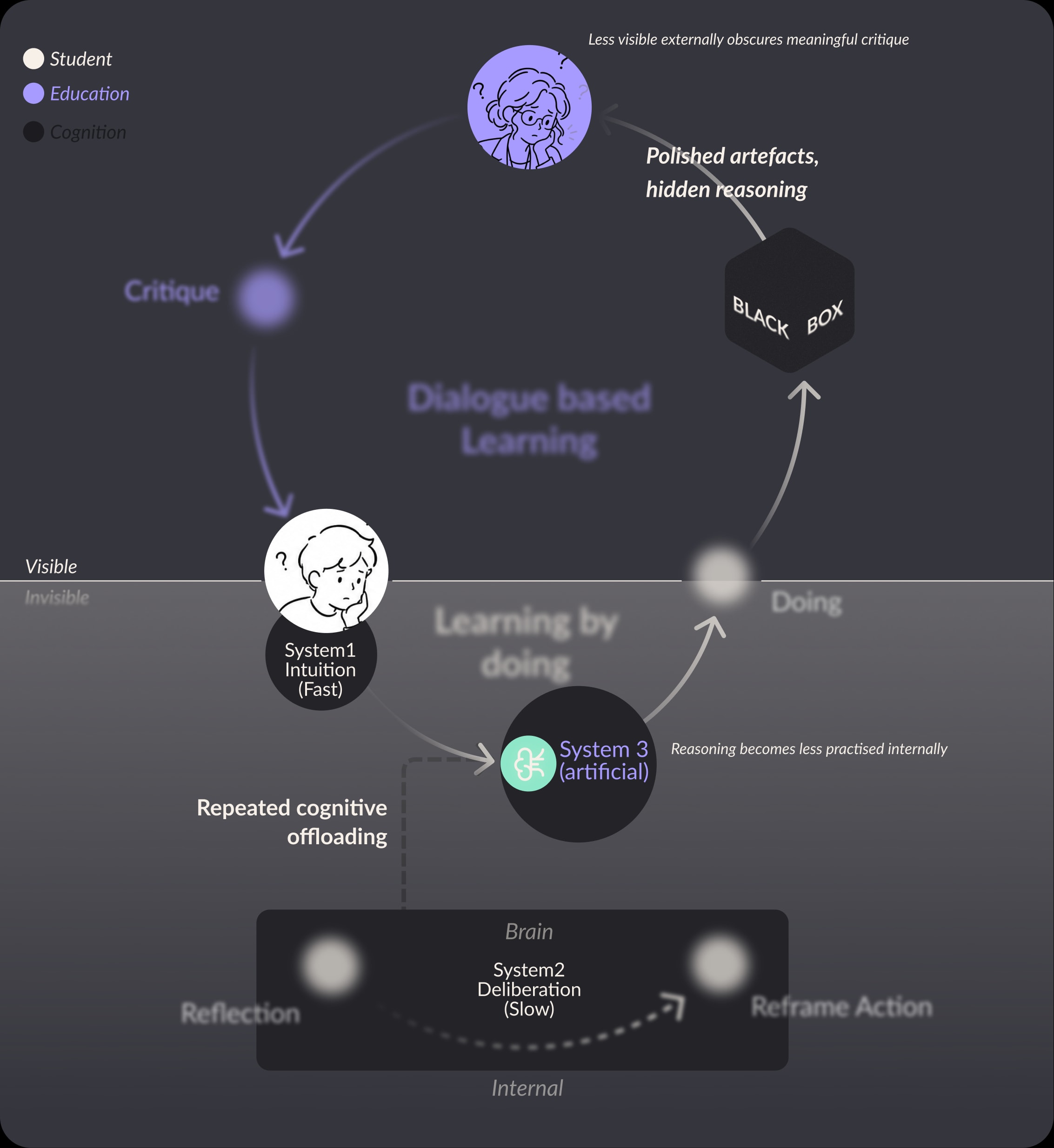
When AI repeatedly performs interpretation and judgement on the user's behalf, fewer opportunities remain to practise the questioning, reframing and deliberation through which independent professional judgement develops.
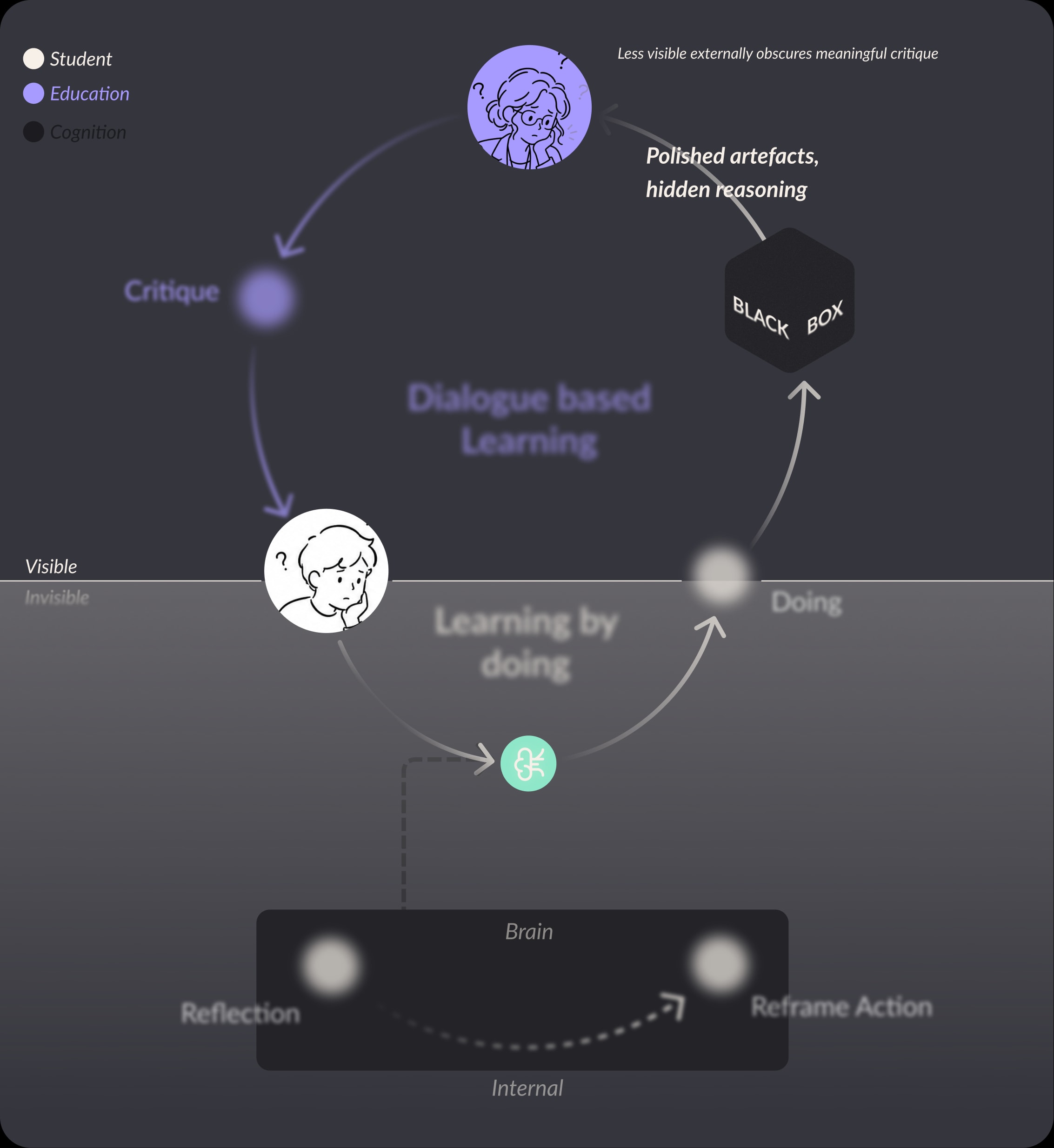
When polished outputs obscure how reasoning developed, educators have less visibility into what students understand, where uncertainty remains and where meaningful critique or scaffolding is needed.
AI may be changing not only what student and junior service designers produce, but also how they develop the judgement, patience, confidence and reflective capabilities required to practise independently.
How might we help students use generative AI in ways that keep their thinking visible and critical reflection active — so AI strengthens rather than bypasses the development of professional judgement?
Keep interpretation, questioning and judgement active during Human–AI interaction.
Make reasoning visible enough to support dialogue, scaffolding and meaningful intervention.
External representations can become persistent, manipulable objects to think with.
Small interruptions or moments of slowness can create space for reflection.
AI can question, explain, discuss and scaffold rather than simply complete the task
Delegation, verification and final judgement remain human-led when using AI.
Externalised thinking can become material for critique and reflective dialogue.
Safe place to experiment with AI to help students understand conflict effects
Second Thought was not the starting concept.
Bring AI-assisted learning into a shared environment where tutors can scaffold, discuss and intervene.
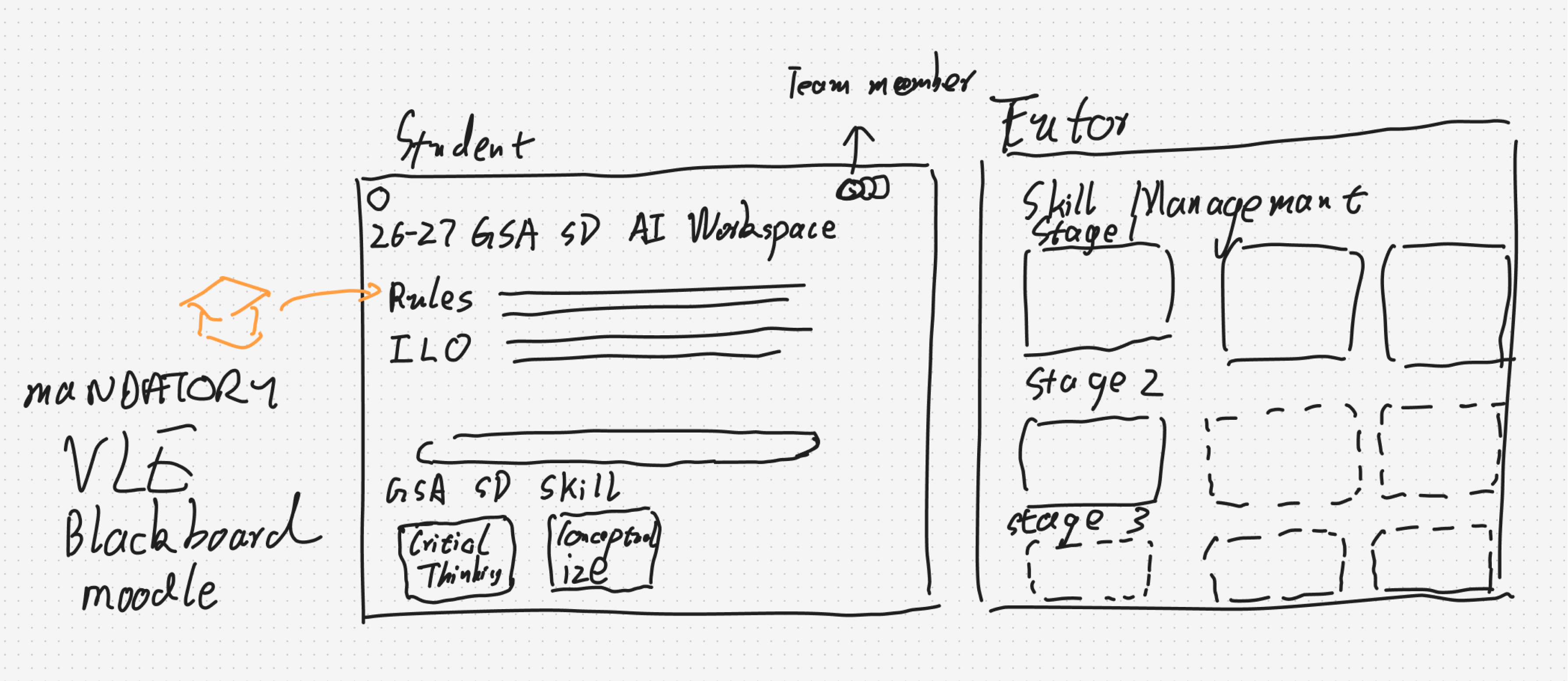
Externalise critical moments of Human–AI reasoning so students can recognise, question and articulate how their thinking develops.
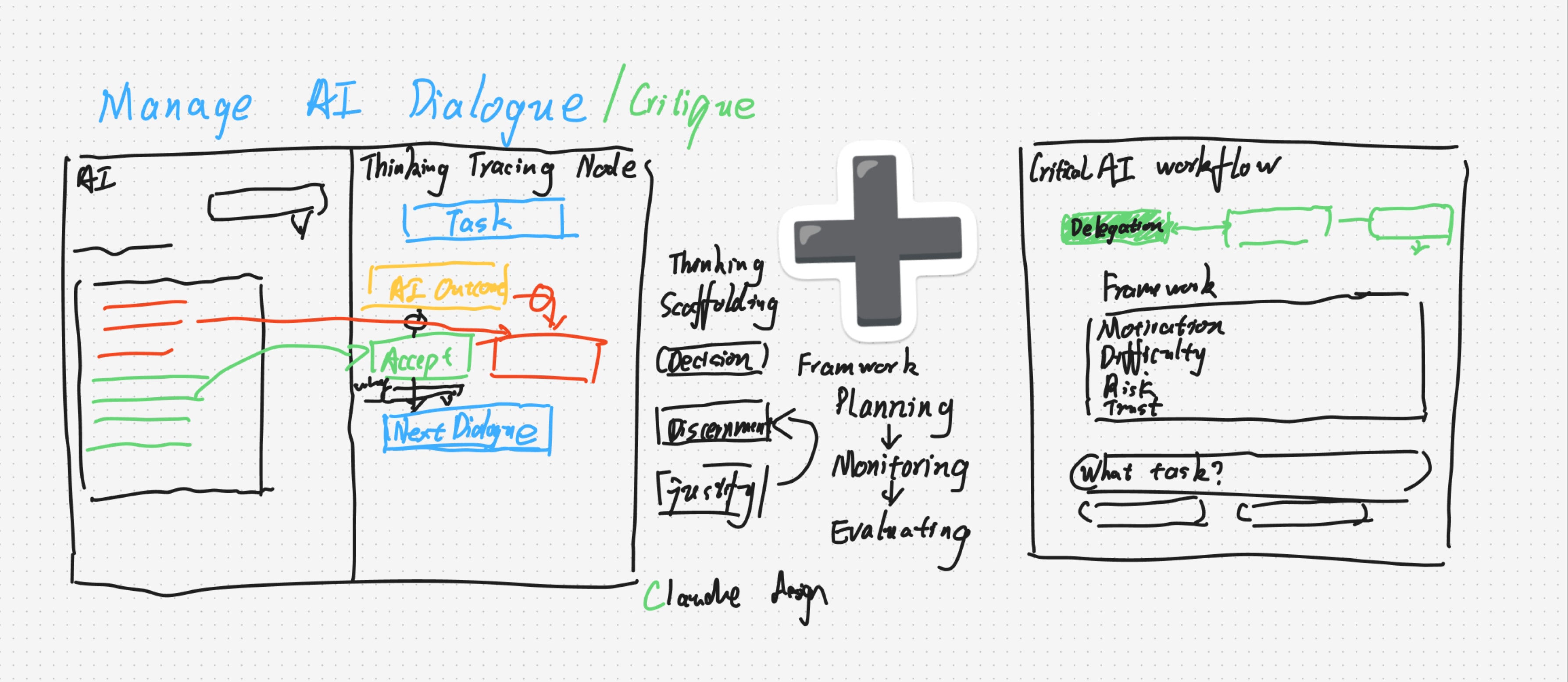
Stronger alignment with student needs and the core capability problem, with fewer concerns around monitoring, control and implementation complexity.
Can spatial interaction make Human–AI reasoning easier to follow?
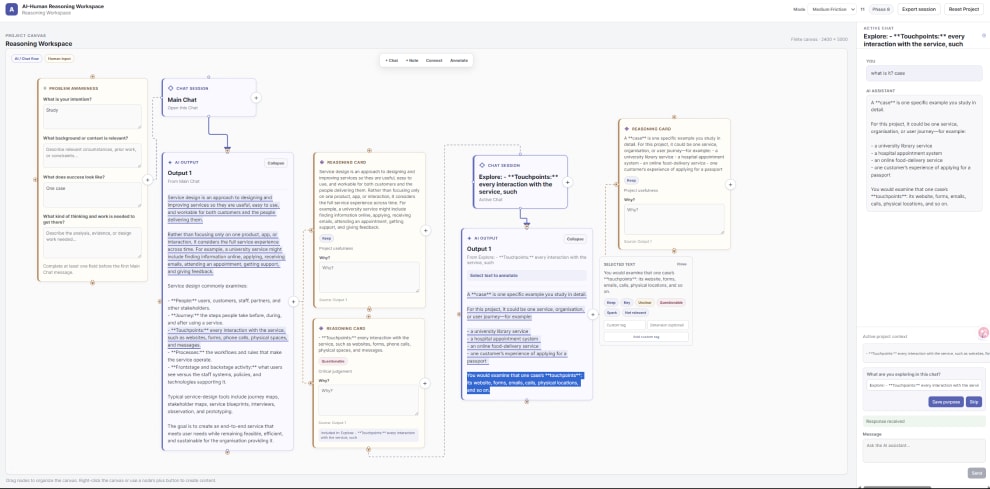
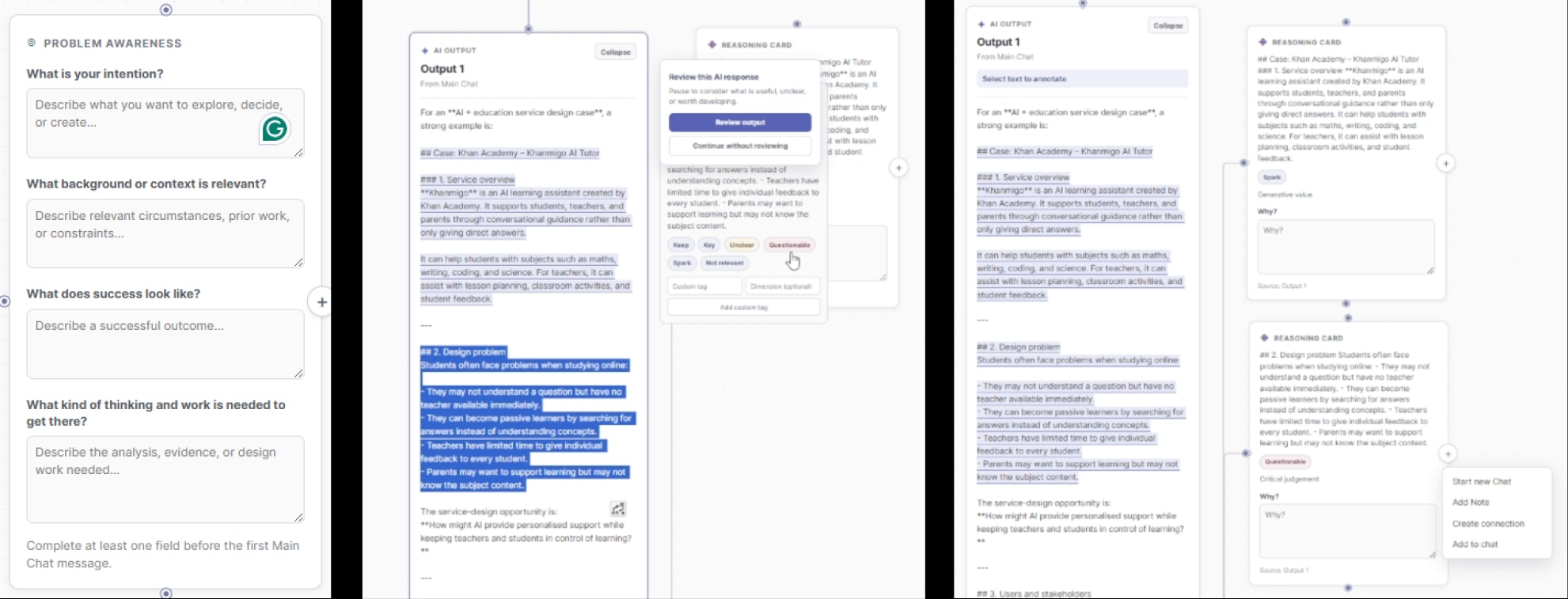
Can selective friction bring people back into interpretation and judgement?
11 participants · 2 iterative rounds
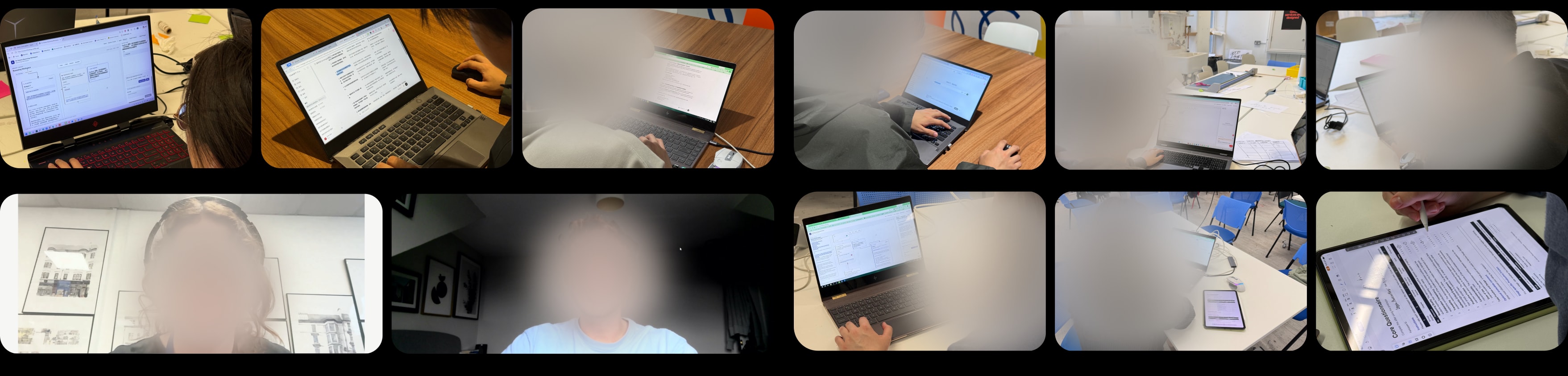
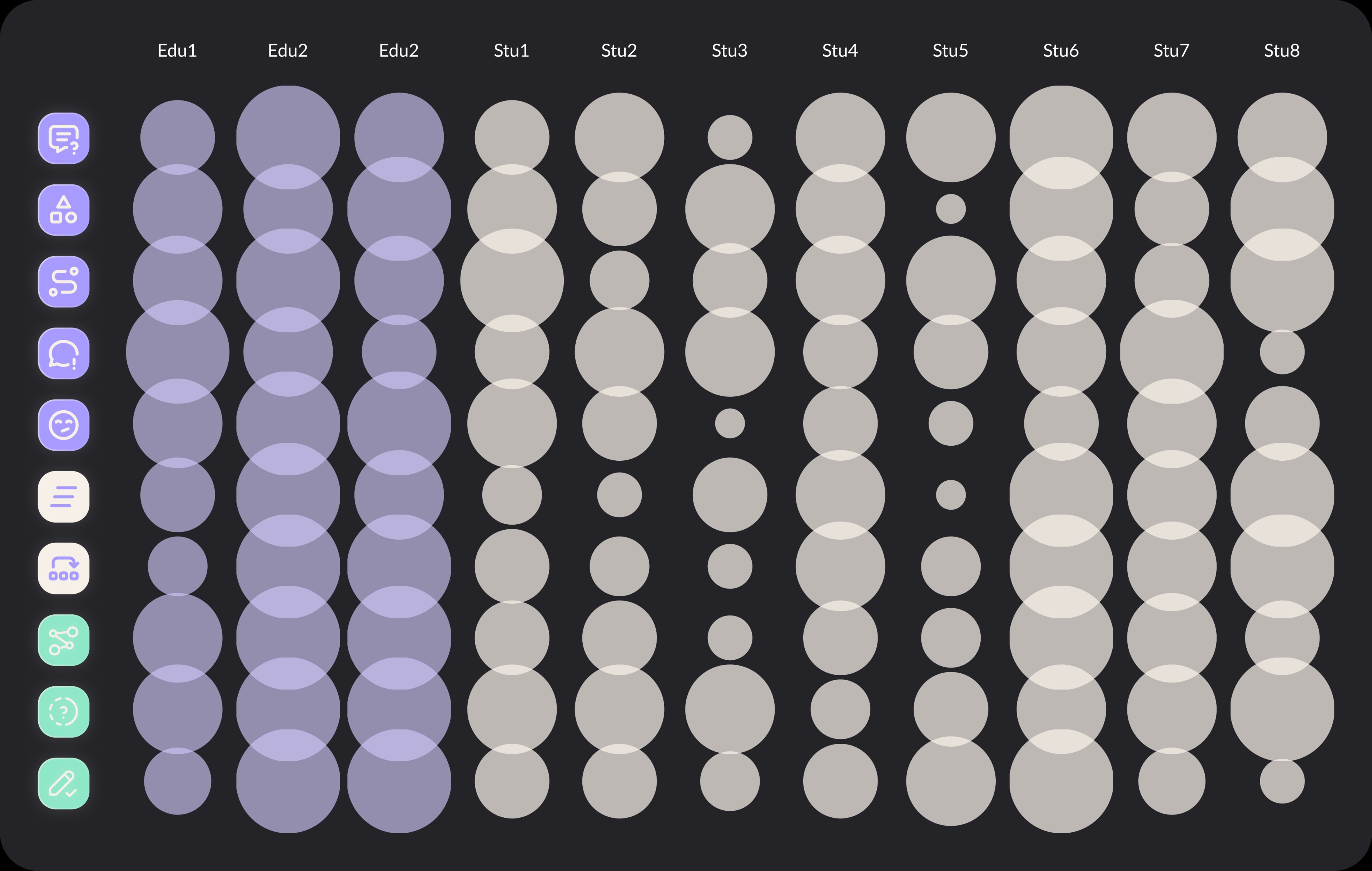
Interaction mechanics alone did not guarantee that users were genuinely questioning AI output.
Selecting and annotating something does not necessarily mean the student has questioned it.
“Spoon-feeding” and overly agreeable AI could still encourage premature acceptance.
…sometimes AI feels like it's spoonfeeding people.
Reflection created value at some moments, but became unnecessary interruption at others.
When I'm trying out this product and haven't seen any results yet, asking me to enter information right away might put me off a bit.
Evidence changed three major product decisions.
Branch and connect ideas while carrying relevant context into each line of inquiry.
Choose how AI participates while reducing automatic agreement.
Vary how strongly users are asked to re-enter the thinking process.
Turn AI output into evidence, interpretation, insight and decisions that remain traceable.
Provenance shows contribution and influence — not truth.
The deployed prototype was independently tried by a J.P. Morgan Service Design Vice President, followed by structured ratings and open feedback.
7-point evaluation following independent product use by one external expert.
“You’re powering your thinking with AI, but at the same time, it remains yours.”
Visible reasoning and retained ownership became distinctive once experienced.
The landing experience initially felt too similar to a standard AI chatbot.
Richer document and multi-source context.
I deliberately deferred multi-source RAG, a composable Node Library, adaptive supervision and complex-canvas scaling to first validate the core Human–AI collaboration model.
Scope was treated as a product decision — not a list of unfinished features.
Make the difference from a standard AI chat immediately visible.
Support richer documents and multi-source inputs while preserving traceability.
Explore reusable cognitive and AI-interaction capabilities through a Node Library.